


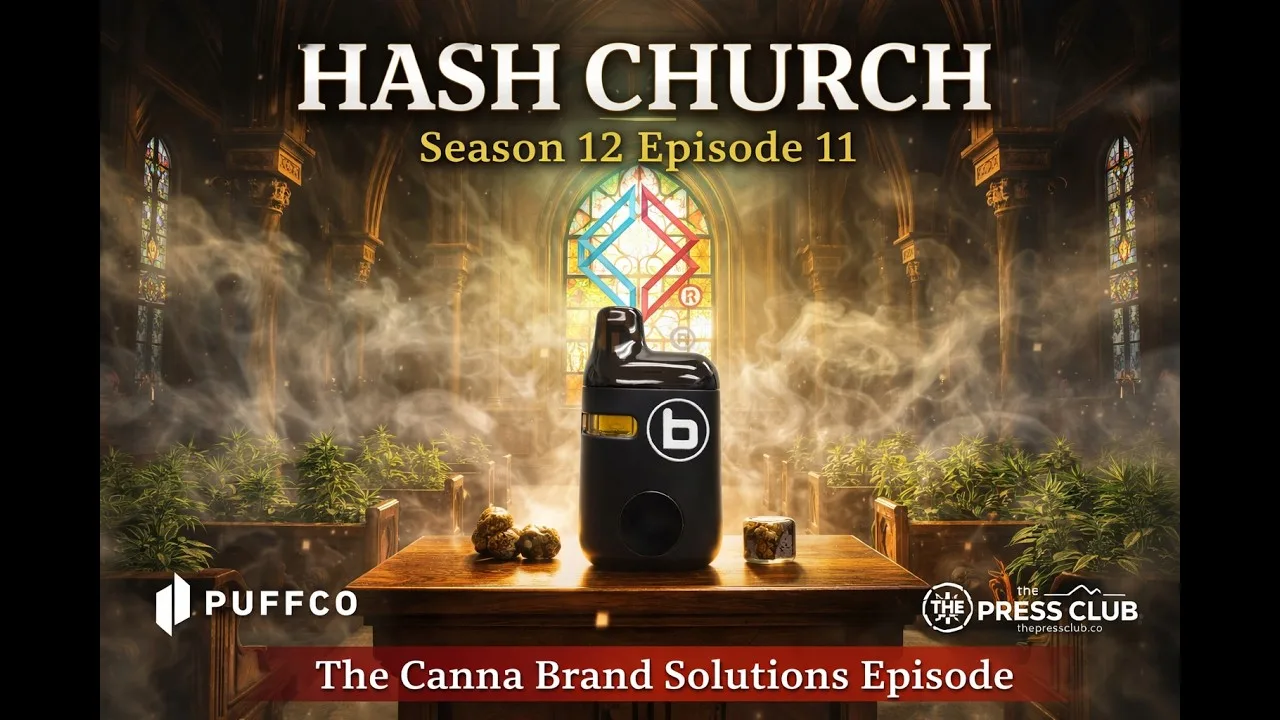

If you’ve ever wondered why one vape hits like a dream—and another tastes like burnt regret—this Hash Church episode is for you.
Bubbleman hosted Hash Church Season 12, Episode 12 with the Canna Brand Solutions team: Daniel Allen (CEO), Marc Berardi (SVP of Sales), and Steven Galinsky (Director of Innovation & Product). The conversation goes deep on what actually matters in modern vape performance: oil behavior, decarb, particle size, and why “cheap hardware” is usually expensive in the long run.
The headline moment: launching the Bubbleman Vision Box All-In-One
Bubbleman opened the episode with the official release of the Vision Box All-In-One built for the Bubbleman brand. It’s positioned as a sleek, powerful, flavor-forward AIO designed to bring solventless culture to a broader audience—without losing authenticity.
The product is part of the Bubbleman brand’s push into Colorado and New Mexico, with potential expansion beyond that.
Daniel Allen’s origin story: from skatepark weed to a packaging-first company
Daniel’s story is a classic “weed + hustle + timing” arc.
- He grew up in Seattle, skating and snowboarding, and started with cannabis young.
- After his father passed, Daniel took over a small importing business that supplied labels and related goods from China.
- He convinced the supplier to support him as he pivoted into cannabis—and Canna Brand Solutions started in 2015 as a packaging company.
Then vape carts happened.
Daniel talks about early cartridges having failure rates that were almost normalized (“15% failure is fine”). He wasn’t buying it. That frustration—and seeing CCELL-style hardware outperform everything else—pushed the company deeper into vape hardware distribution and quality control.
Marc Berardi: why “brand-grade” matters in hardware
Marc’s path is rooted in premium consumer brands and the snowboarding world—then into cannabis when he saw how messy and inconsistent early retail experiences were. He describes trying to find consistent products for migraine relief, then realizing many dispensaries were “dark, dingy” and unhelpful when consumers needed real guidance.
He later moved through vapor categories (including a stint with Pax), and eventually into CCELL’s ecosystem—where he realized how much real engineering and R&D actually exists behind “a little pen.”
The takeaway from Marc’s perspective is straightforward:
Hardware needs brand discipline—clean execution, real R&D, and repeatable performance—because consumers notice drift immediately.
Steven Galinsky: the science behind smooth hits
Steven is the technical anchor of the episode, and he doesn’t talk in vibes. He talks in mechanisms.
1) Rosin raised the bar because the process is unforgiving
Steven explains why solventless is a different beast. Live rosin requires consistent inputs and precise technique—genetics, ice, pressure, temperature, and many small variables that add up. Resin extraction can be more repeatable across strains; rosin demands refinement and attention to detail.
2) The “Goldilocks particle zone”
One of the best sections of the episode is Steven breaking down cough mechanics with a concept he calls the Goldilocks particle zone.
- Too big = hits the throat “like a baseball,” triggers coughing
- Too small = behaves more like gas, irritates the upper airway, triggers sneezing
- The goal is a particle range that supports deeper inhalation with less harshness
He connects this to extract cleanliness too—calling out certain fats (like triglycerides) that don’t vaporize well and can worsen harshness, while noting not all fats behave the same.
3) TPM, puffing machines, and why labs matter
They also talk about using puffing machines and collecting aerosol output (TPM—total particulate mass), then analyzing what’s captured on filter pads using lab instrumentation like GCMS to better understand performance and safety.
The most practical takeaway for processors: “marry the oil to the coil”
This is the part buyers and formulators should screenshot.
The team frames the coil like an engine:
you don’t put diesel in a gas engine and expect it to run clean.
Different oils behave differently—liquid diamonds, distillate, rosin, live resin, HTE—each has different viscosity, boiling point ranges, and residue behavior. The hardware has to be matched to the oil, not the other way around.
They also acknowledge what many processors already live with:
oil is always changing, even within the same facility, and that variability makes hardware tuning a moving target.
Decarb isn’t a footnote. It’s the gatekeeper.
Bubbleman pushes hard on decarb SOPs—because it’s one of the most common reasons a vape fails.
He calls out how early carts would crystallize without proper decarb, and how different decarb approaches can either preserve or destroy the resin’s character. He mentions the Rosin Reactor style approach as an example of sealed processing that can help retain volatile compounds.
On the technical side, the conversation ties decarb directly to:
- viscosity (centipoise)
- particle behavior
- saturation performance
- flavor stability across the life of the device
“Can you fuel the whole market?” Yes—and that’s the point.
A key theme near the end: not every consumer is buying top-shelf solventless.
Bubbleman notes that “swag” (mid and value tiers) is the biggest volume segment, and improving that tier can move the market forward faster than only chasing podium products. The group discusses how low-cost hardware often cuts corners on materials and cleanliness, and why the goal is to improve quality across price tiers without turning every unit into a luxury device.
Where this leaves the industry
This episode is a reminder that “vape hardware” isn’t a commodity.
It’s a system:
- oil prep (especially decarb)
- viscosity behavior
- coil and wicking design
- particle size output
- safety and performance testing
When those are aligned, consumers get:
- better flavor
- fewer clogs
- fewer returns
- fewer “why does this taste like the device?” complaints
And brands get something even better:
repeat purchase.
Want to talk hardware, oil compatibility, or a new AIO concept?
Canna Brand Solutions works with brands and processors to match hardware to oil, tune for performance, and bring products to market with packaging and production support.
Reach out: sales@cannabrand-solutions.com