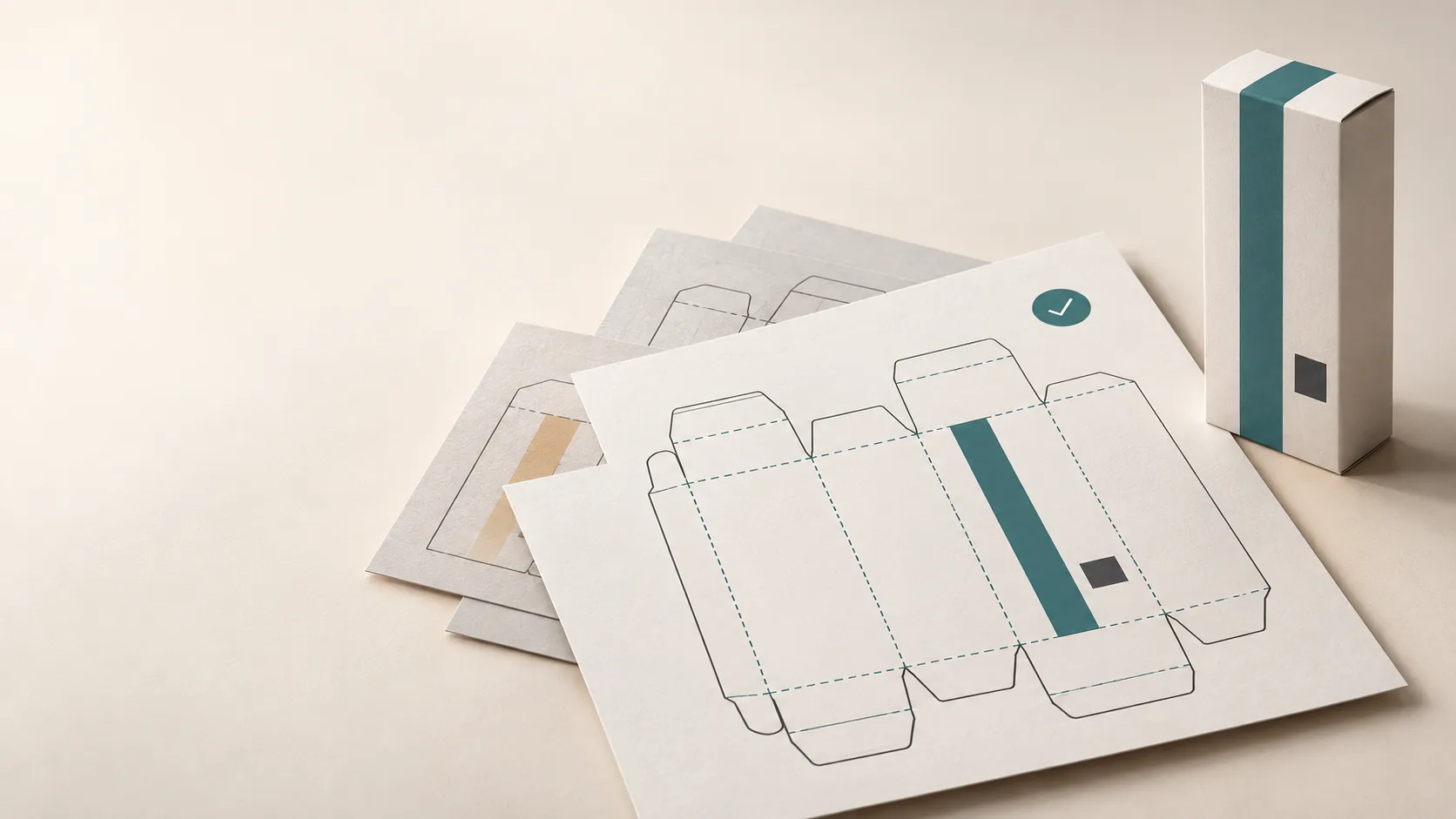





Getting your cannabis packaging right means getting your dieline right first. A dieline is the flat blueprint that tells manufacturers exactly where to cut, fold, and print your packaging. When dieline errors slip through, they create compliance rejections, production delays, and wasted inventory. Canna Brand Solutions works with cannabis brands daily to catch these issues before they become costly problems.
This article breaks down eight dieline mistakes that slow down cannabis packaging production and shows you how to avoid each one.
Quick Guide: 8 Dieline Mistakes That Delay Cannabis Packaging Production
- Missing bleed areas: The top cause of white edges and reprints
- Incorrect fold line placement: Causes misaligned panels and closure failures
- Artwork outside safe zones: Leads to trimmed logos and unreadable text
- Wrong color mode: Creates unexpected color shifts in final prints
- Non-production-ready files: Missing fonts and low-resolution images delay prepress
- Ignoring material thickness: Results in boxes that don’t close properly
- Skipping 3D prototyping: Hides structural problems until production
- Forgetting compliance panel space: Forces last-minute redesigns for warning labels
How We Identified These Dieline Mistakes
These eight errors come from real production feedback across the cannabis packaging industry. Manufacturers, printers, and brand managers consistently report the same issues causing delays.
- Production impact: Each mistake directly causes rejected files, reprints, or assembly failures
- Frequency: These errors appear across brands of all sizes, from startups to established operators
- Compliance connection: Several mistakes create regulatory approval delays specific to cannabis
- Cost implications: Fixing these issues early saves thousands in wasted materials and rush charges
- Resolution clarity: Each problem has a clear fix that your team can implement immediately
The 8 Dieline Mistakes Slowing Cannabis Packaging Production
1. Missing Bleed Areas: The Top Source of Reprints

Bleed is the artwork that extends beyond your cut line, typically 3mm on each side. When background colors or images stop exactly at the trim line, even tiny cutting variations leave visible white edges on your finished boxes.
Cannabis packaging often features bold colors and full-coverage designs that make this problem obvious. A slight shift during die-cutting creates an uneven border that undermines your brand’s professional appearance.
Canna Brand Solutions includes bleed requirements in every dieline template to prevent this issue before files reach production.
Why Bleed Matters for Cannabis Packaging
- Die-cutting tolerance: High-speed cutting machines shift slightly between passes, and bleed accommodates this movement
- Multi-panel alignment: Boxes with wraparound graphics need continuous color across folds, which requires bleed on interior panels
- Reprint prevention: Adding proper bleed takes minutes during design but saves days of production delays when missing
Missing Bleed Areas: Pros and Cons
Pros of proper bleed:
- Eliminates white edges on finished packaging
- Allows die-cutting tolerance without visible errors
- Maintains color consistency across all production runs
Cons of missing bleed:
- Requires file rejection and revision before printing can begin
- Creates inconsistent edge appearance across a single batch
- Adds unplanned design revision time to your production schedule
2. Incorrect Fold Line Placement

Fold lines tell the manufacturer where to crease your packaging so panels align correctly when assembled. When these lines sit even 1mm off position, flaps don’t meet properly, closures fail, and boxes look crooked on shelf.
Cannabis cartridge boxes and child-resistant packaging depend on precise fold placement for both function and compliance. A misaligned tuck flap can prevent proper closure, potentially failing child-resistant testing requirements.
Fold Line Accuracy Benefits
- Panel alignment: Correct fold positions ensure graphics wrap continuously around corners without gaps
- Structural integrity: Proper creases allow packaging to hold its shape during shipping and retail display
- Closure function: Tuck flaps, magnetic closures, and interlocking tabs all depend on exact fold placement
Fold Line Placement: Pros and Cons
Pros of accurate fold lines:
- Boxes close securely and maintain shape during handling
- Graphics align correctly across all visible panels
- Child-resistant mechanisms function as intended
Cons of misplaced fold lines:
- Assembled boxes appear crooked or unprofessional
- Closure mechanisms may fail compliance testing
- Requires new dieline creation and reprinting entire runs
3. Artwork Placed Outside Safe Zones

Safe zones mark the area where text, logos, and critical graphics must stay to avoid getting trimmed or folded out of view. Placing important elements too close to cut lines or fold lines risks partial trimming during production.
Cannabis packaging requires mandatory warning symbols, THC content labels, and batch information that must remain fully visible and legible. Losing even a portion of required compliance text can make your entire production run unsellable.
Safe Zone Protection Benefits
- Logo protection: Keeping brand elements 3–5mm inside cut lines ensures they remain complete on every unit
- Compliance text visibility: Required warnings stay fully readable even with slight cutting variations
- Barcode scanning: UPC codes placed in safe zones scan reliably without edge interference
Safe Zone Placement: Pros and Cons
Pros of respecting safe zones:
- All critical information remains visible on finished packaging
- Compliance elements pass regulatory inspection consistently
- Brand logos appear complete and professional
Cons of ignoring safe zones:
- Warning labels may be partially trimmed, causing compliance rejection
- Barcodes near edges can become unscannable
- Brand elements appear cut off, reducing shelf appeal
4. Wrong Color Mode in Design Files

Packaging files created in RGB color mode print differently than they appear on screen. Commercial printing uses CMYK, and the conversion between modes shifts colors noticeably, especially vibrant greens, blues, and purples common in cannabis branding.
A brand color that looks perfect on your monitor may print as a duller or different shade. Discovering this after a full production run means choosing between off-brand packaging or expensive reprints.
Color Mode Conversion Benefits
- Accurate brand colors: Working in CMYK from the start shows how your packaging will look when printed
- Pantone matching: For exact color consistency, specify Pantone (PMS) colors in your dieline files
- Proof approval: CMYK files produce accurate proofs, reducing surprises during final production
Color Mode: Pros and Cons
Pros of CMYK workflow:
- Printed colors match your approved proofs accurately
- Brand identity stays consistent across all packaging SKUs
- Eliminates color-related reprints and delays
Cons of RGB file submission:
- Vibrant screen colors become muted or shifted in print
- Color proofs don’t predict final printed appearance
- Brand consistency suffers across different production batches
5. Non-Production-Ready Artwork Files

Production-ready files arrive with fonts outlined, images at 300 DPI minimum, and all elements properly embedded. Files missing these requirements get flagged during prepress review, adding revision cycles before printing can start.
Missing fonts cause text to reflow or substitute with default typefaces. Low-resolution images appear pixelated on printed packaging. Both issues require file fixes and re-approval, extending your timeline.
File Preparation Requirements
- Outlined fonts: Converting text to outlines prevents font substitution on production systems
- High-resolution images: 300 DPI at actual print size ensures sharp reproduction
- Embedded assets: Including all linked files prevents missing image warnings
Production-Ready Files: Pros and Cons
Pros of proper file preparation:
- Files pass prepress review without revision requests
- Printed graphics appear sharp and professional
- Production timelines stay on schedule
Cons of incomplete files:
- Prepress holds for missing fonts extend timelines by days
- Low-resolution graphics force file replacement and re-proofing
- Missing linked images cause unexpected blank areas in proofs
6. Ignoring Material Thickness in Dimensions

Packaging material has thickness that affects how boxes fold and fit together. A dieline designed for 12pt paperboard won’t work correctly with 18pt stock because the thicker material changes how panels wrap around each other.
Cannabis packaging often uses heavier stocks for premium appearance and child-resistant features. Failing to account for this thickness creates boxes that don’t close properly or products that fit too tightly inside.
Material Thickness Considerations
- Panel wrapping: Thicker materials need slightly larger outer dimensions to accommodate interior folds
- Closure fit: Tuck flaps and magnetic closures require adjustment based on stock thickness
- Product fit: Interior dimensions must account for material folding inward at corners
Material Thickness: Pros and Cons
Pros of thickness-adjusted dielines:
- Boxes fold and close smoothly without forcing or gaps
- Products fit securely without rattling or compression
- Child-resistant closures function correctly
Cons of ignoring material thickness:
- Assembled boxes may not close completely or pop open
- Products may fit too loosely or require forcing during packing
- Requires dieline revision and new die creation
7. Skipping 3D Prototyping Before Production

Flat dielines don’t reveal how packaging will look and function when assembled. Three-dimensional prototypes expose alignment issues, structural weaknesses, and design problems that aren’t visible in 2D artwork review.
Canna Brand Solutions creates digital mock drafts and 3D product renders to eliminate surprises during the design process. This step catches problems when fixes cost minutes instead of thousands in scrapped inventory.
3D Prototyping Benefits
- Structural validation: Physical or digital samples confirm boxes hold shape and close properly
- Graphics review: See how artwork flows across folds and panels before committing to production
- Stakeholder approval: 3D renders help team members visualize final packaging accurately
3D Prototyping: Pros and Cons
Pros of pre-production prototyping:
- Catches structural and alignment issues before die creation
- Allows design refinement without production waste
- Speeds approval by showing stakeholders realistic previews
Cons of skipping prototypes:
- Structural problems appear only after production begins
- Design misalignments require reprinting and new dies
- Approval delays occur when stakeholders see unexpected results
8. Forgetting Compliance Panel Space Requirements

Cannabis packaging regulations specify minimum sizes and placement requirements for warning labels, THC symbols, and batch information. Dielines that don’t allocate space for these elements require redesigns that push back production schedules.
Regulations also change by state and over time. Building flexibility into your dieline allows compliance updates without complete redesigns. Canna Brand Solutions builds adaptive custom packaging that accommodates regulatory requirements across different markets.
Compliance Space Planning Benefits
- Dedicated panel areas: Reserving space for required information prevents last-minute layout changes
- Update flexibility: Designs with compliance zones adapt to regulation changes without full redesigns
- Multi-state readiness: Packaging designed with extra label space works across different state requirements
Compliance Planning: Pros and Cons
Pros of planning compliance space:
- Required labels fit without crowding brand elements
- Regulation changes require minimal design adjustment
- Single packaging design works across multiple markets
Cons of inadequate compliance space:
- Label additions force brand elements to be reduced or relocated
- State-specific requirements may require entirely new designs
- Regulation updates trigger emergency redesign projects
Comparison Table: Common Cannabis Packaging Dieline Mistakes
| Dieline Mistake | Production Impact | Typical Delay | Prevention Method |
|---|---|---|---|
| Missing bleed areas | File rejection, reprints | 2–5 days | 3mm bleed on all sides |
| Wrong fold lines | Assembly failure | 5–10 days | Prototype testing |
| Artwork outside safe zones | Compliance rejection | 3–7 days | 5mm interior margin |
| RGB color mode | Color mismatch | 3–5 days | CMYK from start |
| Non-ready files | Prepress holds | 2–4 days | Outlined fonts, 300 DPI |
| Wrong thickness calc | Fit problems | 7–14 days | Material-specific dieline |
| No prototype | Late discovery issues | 10–21 days | 3D render review |
| No compliance space | Regulatory rejection | 5–14 days | Dedicated label panels |
How Do Dieline Errors Affect Cannabis Packaging Compliance?
Cannabis packaging faces stricter regulatory requirements than most consumer products. Warning labels must appear at specific sizes, THC symbols need minimum dimensions, and child-resistant features must function exactly as certified.
Dieline errors that seem minor in other industries become serious compliance problems in cannabis packaging. A misplaced fold line can hide required warnings. An undersized safe zone might trim mandatory text. These issues trigger regulatory rejection and require complete production restarts.
Working with a packaging partner who understands cannabis-specific requirements prevents these costly delays. Canna Brand Solutions designs packaging that meets regulatory requirements from the first draft.
What Makes Cannabis Packaging Dielines Different From Standard Packaging?
Cannabis packaging dielines must accommodate requirements that don’t apply to other consumer products. Child-resistant closures, tamper-evident features, and mandatory compliance panels all add complexity to structural design.
Standard packaging dielines focus primarily on aesthetics and basic function. Cannabis packaging dielines must balance brand presentation with regulatory compliance, product protection, and specialized closure mechanisms that pass testing certification.
This complexity makes working with cannabis-experienced packaging partners valuable. Generic packaging suppliers may not understand how regulatory requirements interact with structural design decisions.
Why Canna Brand Solutions Is the Leading Partner for Cannabis Packaging Dielines
Canna Brand Solutions combines in-house creative design with deep cannabis industry knowledge to eliminate dieline problems before production. From digital mock drafts to 3D product renders, our process catches errors when they cost minutes to fix rather than weeks of delayed launches.
Our team works with cannabis manufacturers and brand managers daily, understanding the specific compliance requirements and production challenges your packaging faces. Whether you need cartridge boxes, pre-roll tubes, or edible packaging, we build dielines that work correctly the first time.
Canna Brand Solutions delivers adaptive custom packaging solutions with established domestic and international manufacturing partners ensuring quality and timely production. Our sample and approval process ensures your satisfaction before any full production commitment.
Ready to eliminate dieline delays from your packaging timeline?
Contact Canna Brand Solutions to discuss your next project with a team that knows cannabis packaging inside and out.
FAQs About Cannabis Packaging Dielines
A dieline is a two-dimensional template showing where your packaging will be cut, folded, and printed. It serves as the blueprint that tells manufacturers exactly how to produce your boxes, tubes, or pouches. Canna Brand Solutions creates dielines specifically designed for cannabis product requirements.
Dieline errors require file corrections, new proofs, and sometimes new cutting dies before production can proceed. Each revision cycle adds days or weeks to your timeline. Catching problems through prototyping prevents these delays from affecting your launch schedule.
Standard bleed requirement is 3mm (approximately 1/8 inch) beyond the cut line on all sides. This allows for normal cutting tolerances without leaving white edges. Canna Brand Solutions includes proper bleed specifications in every dieline template we create.
Dielines can work across multiple states if designed with adequate compliance panel space. Different states require different warning labels and symbols, so building flexibility into your layout accommodates these variations. Canna Brand Solutions designs packaging that adapts to various state requirements.
Production-ready dielines include proper bleed, clearly marked fold and cut lines, CMYK color mode, outlined fonts, and high-resolution images. If your file passes prepress review without revision requests, it’s ready. Canna Brand Solutions reviews all artwork before production to catch issues early.
Professional dielines are created in vector software like Adobe Illustrator, ArtiosCAD, or Esko Studio. These programs allow precise line placement and proper layer organization that printing and die-cutting equipment require. Canna Brand Solutions accepts files from all major design platforms.