



A packaging dieline may look like a simple technical file, but one misplaced fold, undersized bleed, or incorrectly positioned compliance panel can delay an entire production run. For regulated cannabis packaging, dieline accuracy affects more than appearance—it influences production speed, packaging performance, compliance readiness, and total project cost.
Cannabis manufacturers and brand managers often focus on visual design while overlooking the technical foundation beneath it. This guide explains how dieline consistency improves manufacturing speed, addresses compliance gaps in current packaging design practices, and connects dieline standards to real production outcomes. Canna Brand Solutions works with cannabis brands to develop packaging that performs from design approval through production and delivery.
Key Takeaways
- Dielines define cut lines, fold lines, bleed areas, safe zones, and glue tabs that control how your packaging is manufactured and assembled.
- Consistent dieline standards reduce production delays by preventing common file errors that require rework and revision cycles.
- Child-resistant features, warning labels, and regulatory panels must be positioned within dieline safe zones to maintain compliance after assembly.
- Canna Brand Solutions eliminates design surprises through digital mock drafts and 3D product renders before production begins.
- Testing your dieline with physical prototypes catches fit, folding, and compliance issues that flat files and renders cannot reveal.
What Is a Packaging Dieline and Why Does It Matter for Cannabis Products?
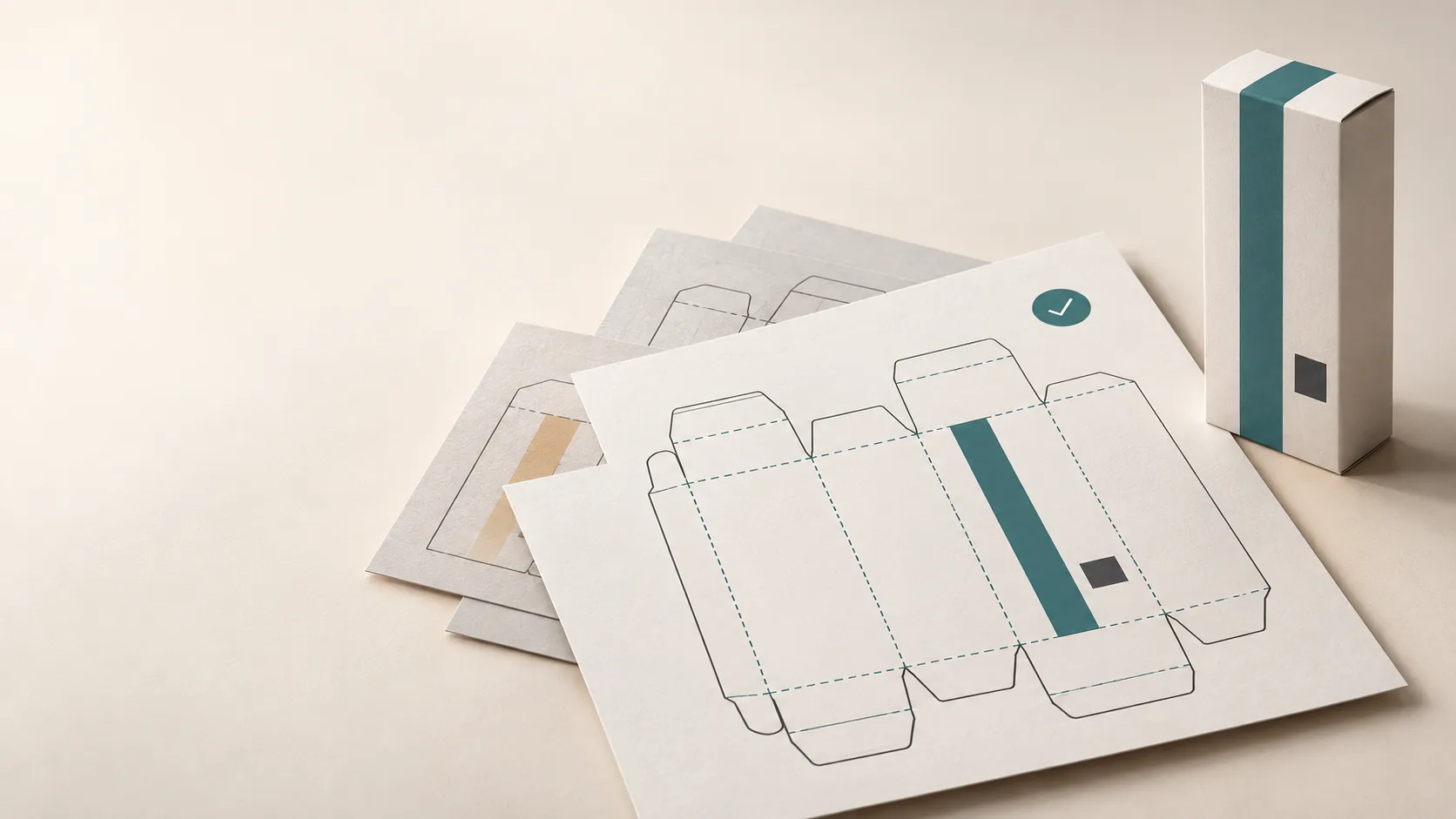
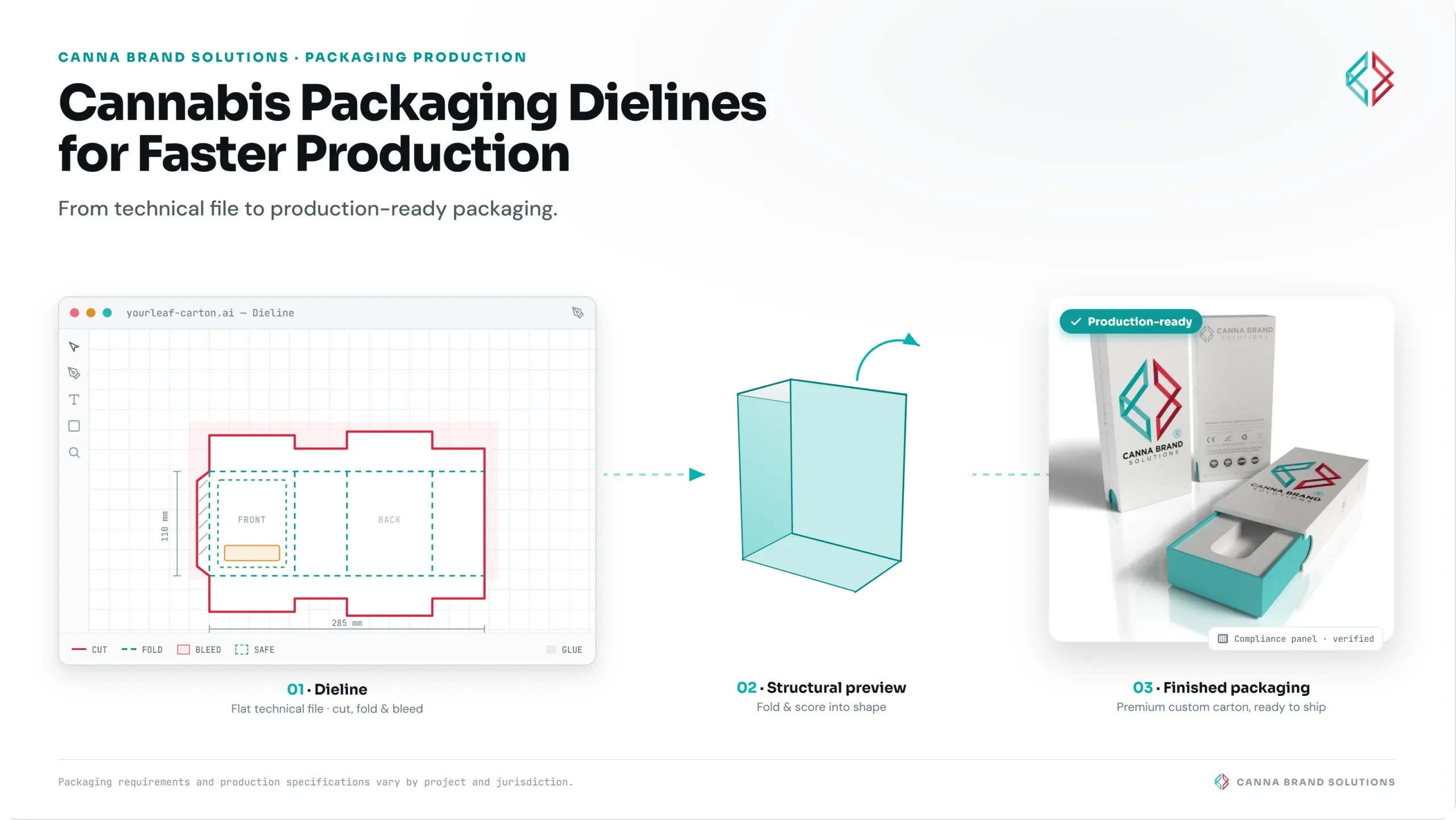
A packaging dieline is a technical template that maps the exact dimensions and layout of your package before production begins. Think of it as an architectural plan that specifies where cuts, folds, scores, and glue applications will occur. Every panel, flap, and closure in your finished package traces back to this flat blueprint.
For cannabis packaging, dielines carry additional weight because your products must meet regulatory requirements while maintaining brand presentation. Child-resistant mechanisms, warning labels, THC symbols, and required text panels all need precise positioning within your dieline structure. If these elements land too close to fold lines or cut edges, they may become illegible or non-compliant after assembly.
When your dielines are built correctly from the start, you avoid the costly cycle of revisions, reprints, and production holds that drain time and budget.
How Do Dieline Components Affect Manufacturing Speed?
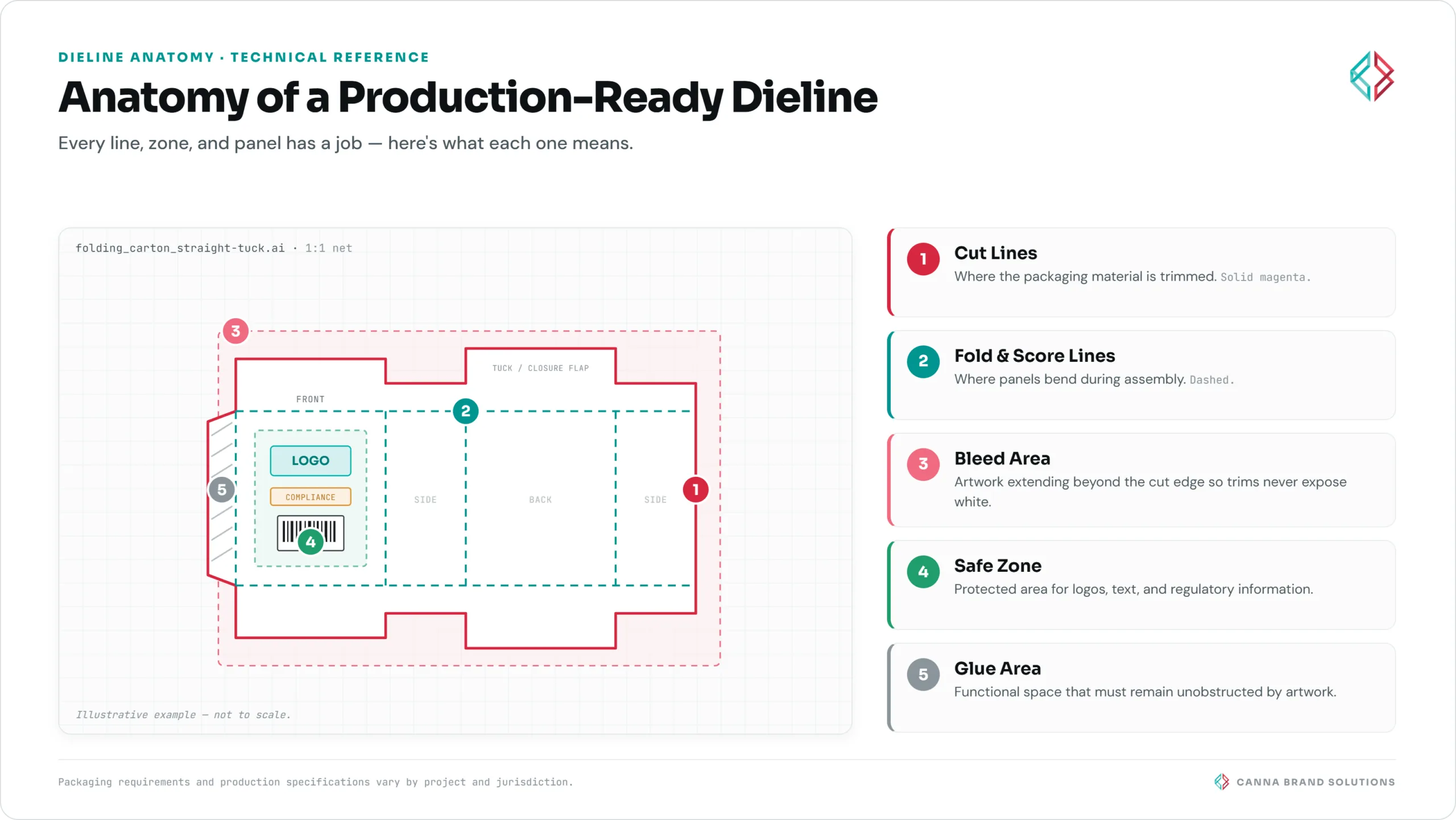
Every dieline contains specific elements that control how your packaging moves through production equipment. Understanding these components helps you communicate more effectively with your packaging partner and catch potential issues before they become expensive problems.
Cut Lines
Cut lines show where die-cutting equipment will trim your packaging material. These are typically represented as solid lines on your dieline template. If cut lines are positioned incorrectly or don’t account for material tolerance, you’ll see white edges, uneven panels, or artwork that stops short of where it should.
Fold and Score Lines
Fold lines indicate where your packaging will crease during assembly. Score lines create controlled breaks that allow the material to bend cleanly. Material thickness and grain direction affect how well folds perform. If your dieline doesn’t account for these factors, you may see cracking, misaligned panels, or boxes that fight against their intended shape.
Bleed Areas
Bleed extends your artwork beyond the cut line, typically by 1/8 inch. This buffer zone accounts for minor shifts during trimming and prevents white edges from appearing on your finished packaging. Missing bleed is one of the most common dieline errors that triggers production delays.
Safe Zones
Safe zones define the interior boundary where important content should stay. Text, logos, barcodes, and regulatory information placed too close to cut or fold lines may be trimmed off or distorted after assembly. For cannabis packaging with mandatory compliance elements, safe zone violations can make your entire production run unusable.
Glue Areas
Glue tabs indicate where adhesive will bond your package together. Placing artwork or critical information on glue areas creates adhesion problems and hides content after assembly. These functional zones should remain clear unless your production partner specifically approves otherwise.
What Dieline Mistakes Cause the Most Production Delays?
Certain dieline errors appear repeatedly across cannabis packaging projects. Recognizing these patterns helps you build review processes that catch problems early, before they multiply into production delays and compliance failures.
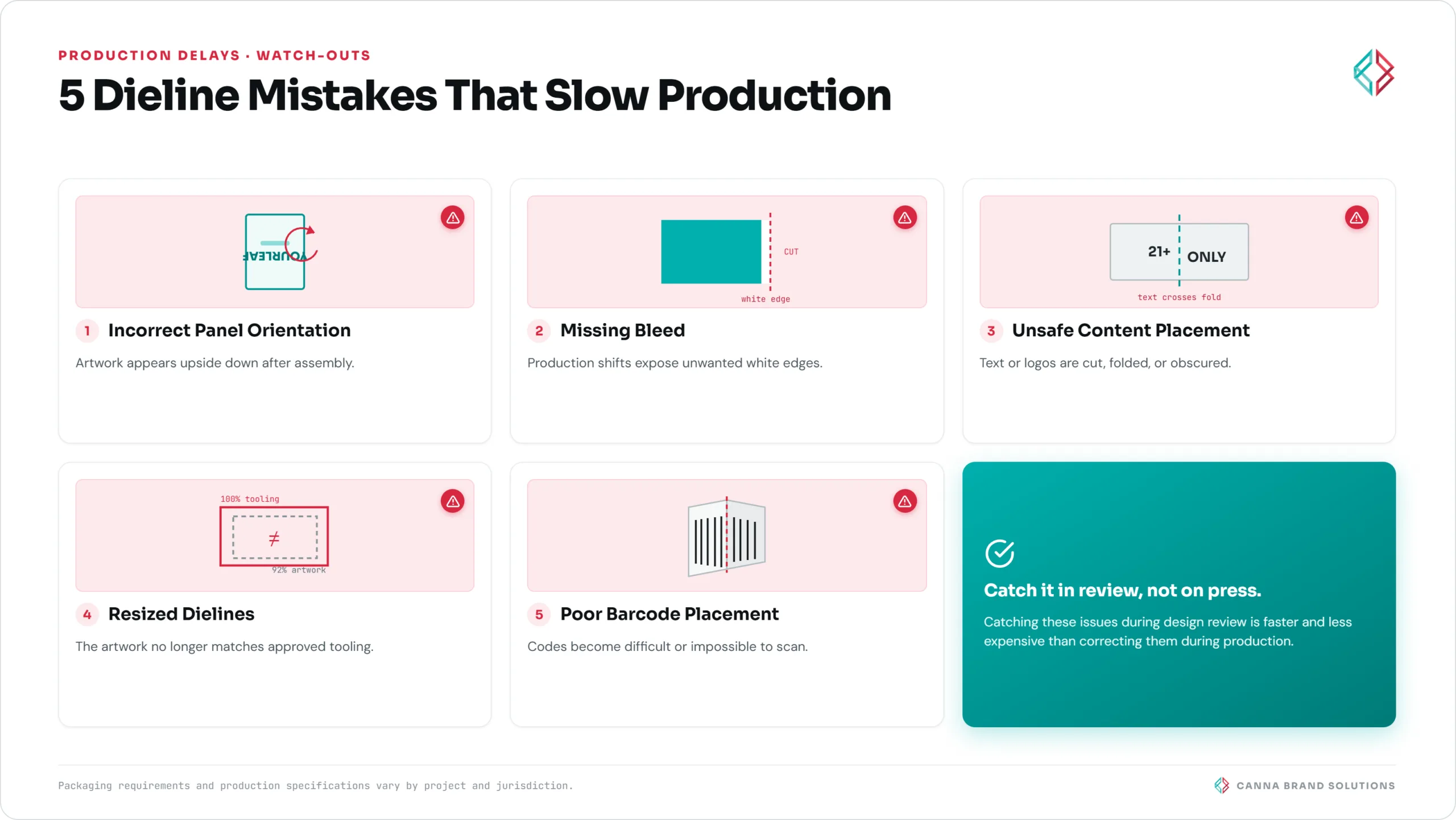
Panel Orientation Errors
A dieline is flat, but your finished package exists in three dimensions. Artwork that looks correct in the flat file may appear upside down, on the wrong panel, or split across an unintended fold once assembled. This mistake often doesn’t surface until physical samples arrive, putting your timeline at risk.
Missing or Insufficient Bleed
When artwork stops exactly at the cut line, even small shifts during production create white edges and color inconsistency. Full-color backgrounds, patterns, and product imagery that reach panel edges require proper bleed extension to print cleanly.
Critical Content in Unsafe Positions
Logos, regulatory text, barcodes, and QR codes placed too close to cuts, folds, or glue areas become casualties of normal production tolerance. These elements need breathing room within your safe zones to remain intact and readable.
Resized or Flattened Dielines
When designers scale or modify the dieline to fit artwork, the resulting package no longer matches the approved structure, tooling, or production setup. This seemingly minor change can create cascading problems with fit, folding, and product compatibility that require starting over.
Barcode and QR Code Placement Issues
Barcodes placed across fold lines, too close to edges, or in low-contrast areas may not scan after assembly. For cannabis retailers who depend on inventory systems and compliance tracking, unreadable codes create operational problems that trace back to dieline decisions.
How Does Dieline Consistency Speed Up the Production Workflow?
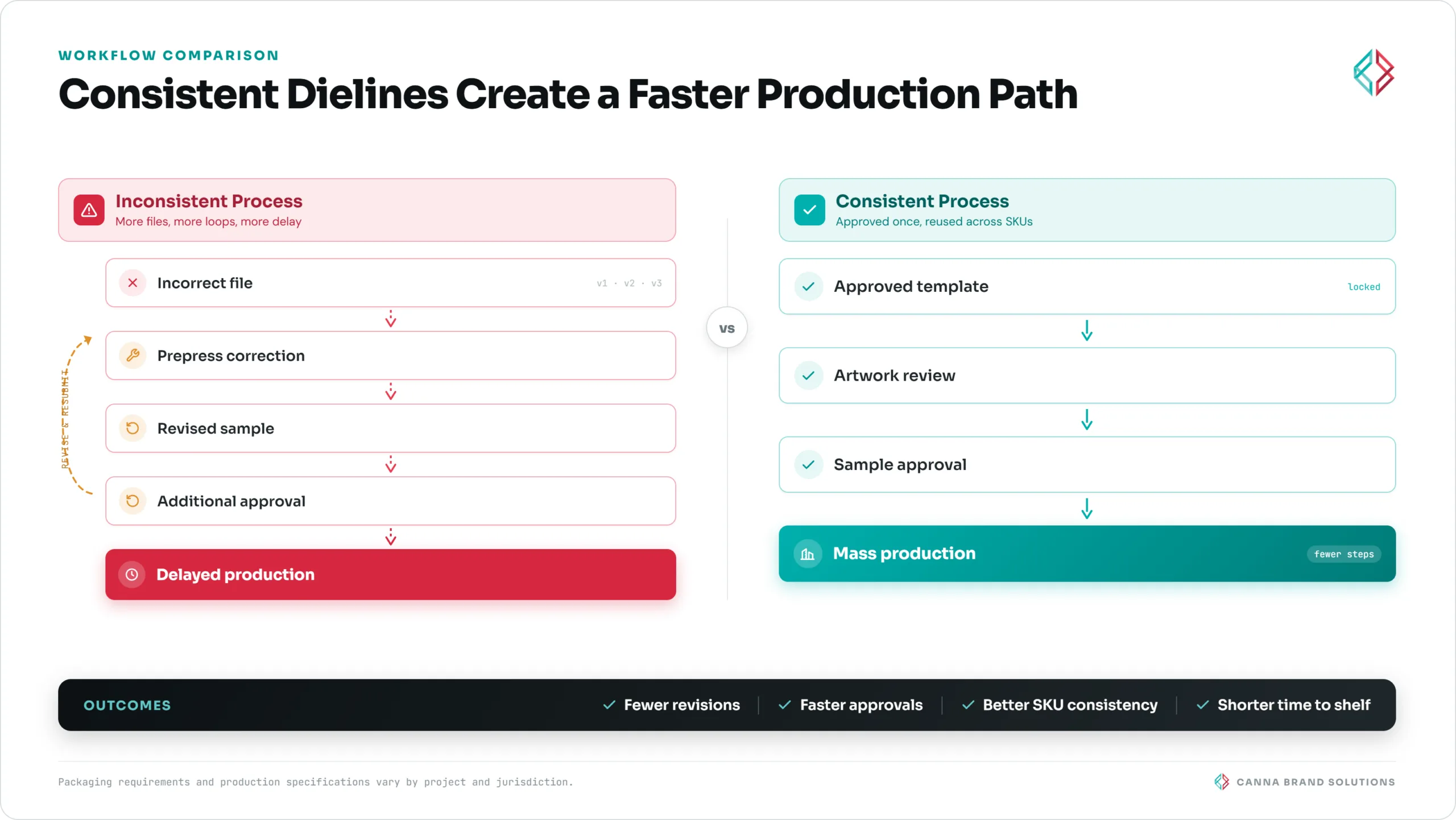
A well-structured dieline accelerates production at every stage because it reduces the back-and-forth communication that slows down approval cycles, eliminates file corrections during prepress, and creates predictable behavior on manufacturing equipment.
When your dielines follow consistent standards across product SKUs, your packaging partner can process files faster, produce samples with fewer revision rounds, and maintain quality throughout mass production. Canna Brand Solutions offers design services that include dieline development and artwork review to catch issues before they affect your production schedule.
Consistency also pays dividends when you expand your product line. Dieline templates built to established standards can be adapted for new SKUs without rebuilding from scratch, shortening your time-to-shelf for future launches.
What Role Do Dielines Play in Cannabis Compliance?
Cannabis packaging must display specific regulatory elements depending on your market. Warning labels, THC symbols, child-resistant certifications, and information panels all have placement requirements that interact with your dieline structure.
According to the California Department of Cannabis Control, cannabis goods must be packaged in child-resistant, tamper-evident, and resealable packaging that prevents product contamination. Your dieline determines whether child-resistant features function correctly after assembly and whether required information appears in the correct locations.
If compliance panels are positioned within fold zones, critical warnings may crease and become unreadable. If child-resistant mechanisms conflict with your structural design, the packaging may pass visual inspection but fail functional testing. These issues trace back to dieline decisions made before anyone printed a single sheet.
How Should You Test Dielines Before Mass Production?
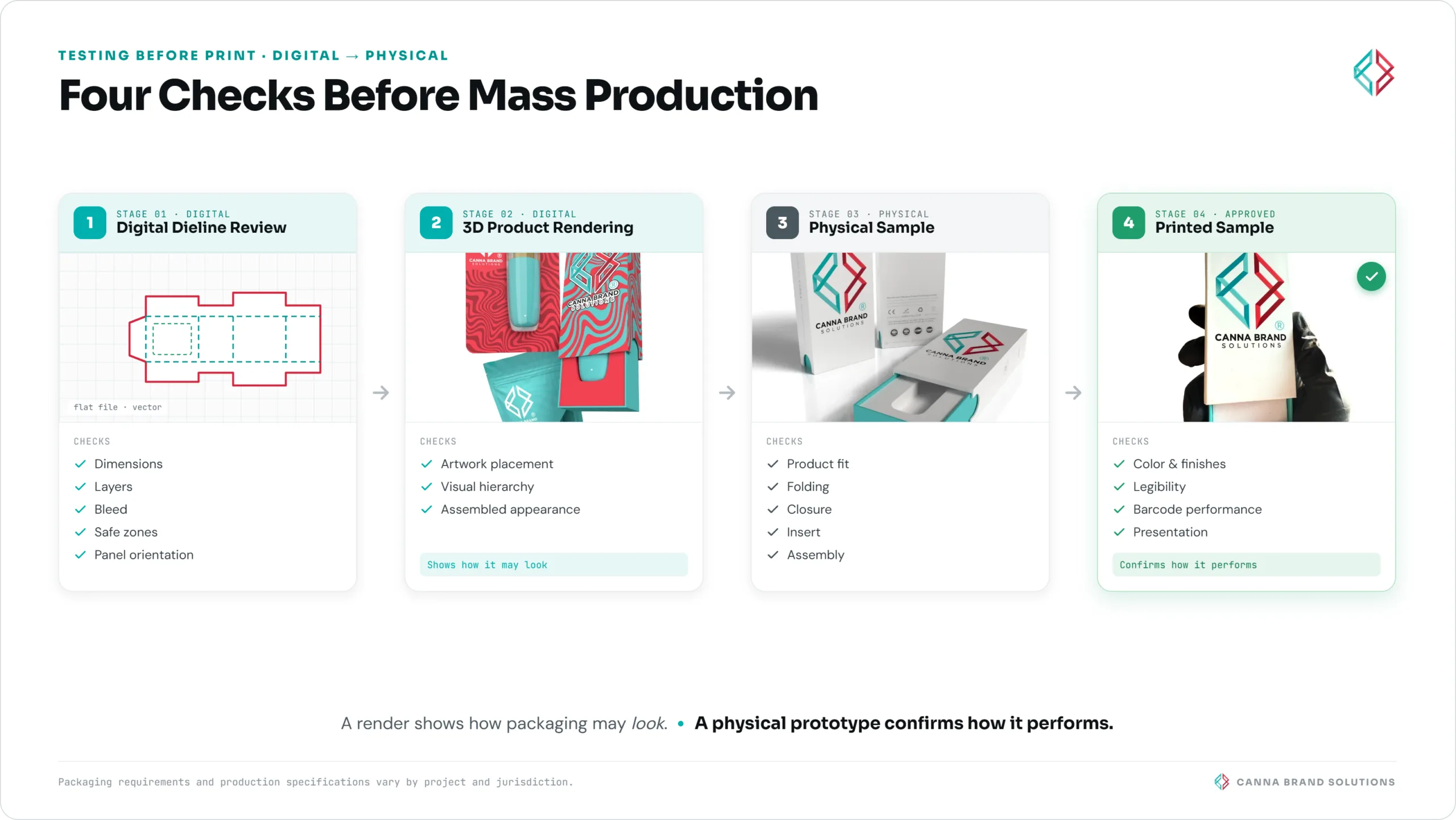
Physical prototyping catches problems that flat files and digital renders cannot reveal. Testing your dieline with actual samples confirms fit, validates folding behavior, and identifies compliance risks before you commit budget to mass production.
White Dummy Testing
A white dummy uses your production material without final printing. This structural sample tests product fit, opening behavior, insert positioning, closure strength, and assembly logic. You’ll discover whether your cartridge, concentrate jar, or pre-roll actually fits the way your dieline predicts.
Color Proof Validation
After structural approval, color proofs check artwork placement, print quality, and finishing effects. This stage reveals whether your regulatory text is legible, your brand colors match expectations, and your barcode scans correctly in its final position.
Assembly and Handling Tests
Samples that look perfect on a table may perform differently during packing, shipping, and shelf display. Testing how your packaging handles real-world conditions helps identify dieline modifications that improve durability and presentation.
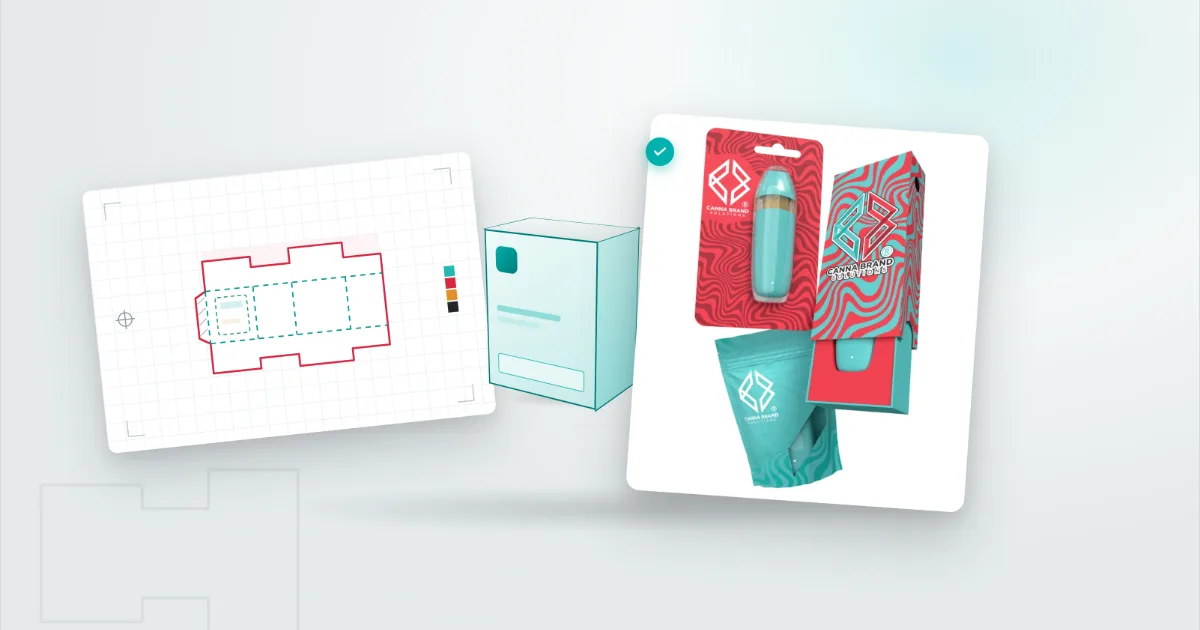
Canna Brand Solutions eliminates surprises throughout the design process by providing digital mock drafts and 3D product renders before production begins. This approach catches dieline issues when changes are simple and inexpensive rather than after tooling and materials are committed.
How Do Different Packaging Formats Affect Dieline Requirements?
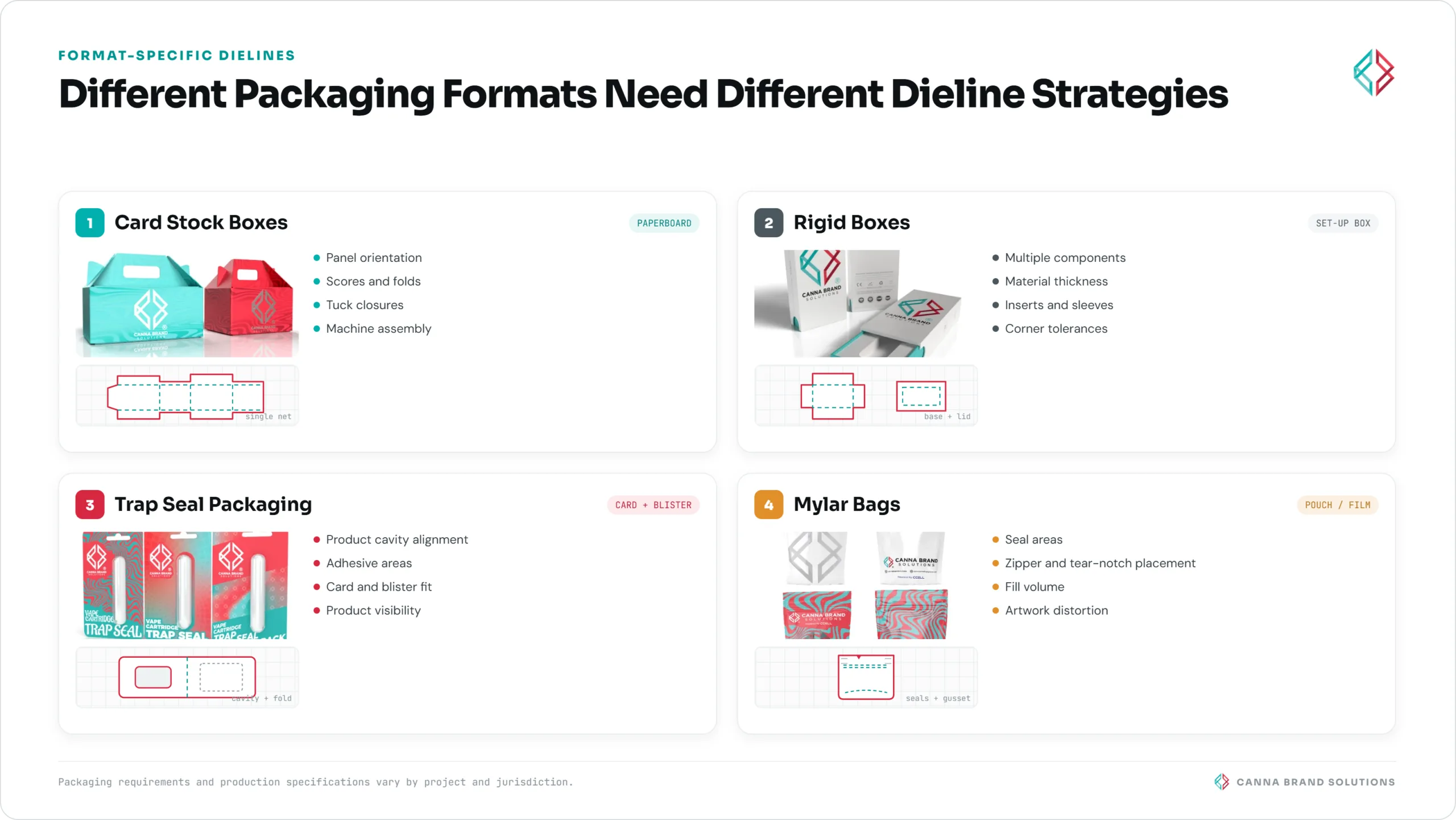
Cannabis products ship in various packaging formats, each with distinct dieline considerations. Understanding how your product format affects structural requirements helps you communicate specifications clearly and avoid format-specific pitfalls.
Folding Cartons
Folding cartons for cartridges, edibles, and concentrates require dielines that account for die-cutting, scoring, and folder-gluer equipment. Panel orientation, dust flap coverage, and tuck closure design all affect how efficiently your cartons run through production.
Rigid Boxes
Rigid boxes involve multiple components: the outer box, lid, insert, and sometimes a sleeve or wrap. Each component has its own dieline, and all must coordinate for proper fit. Rigid box dielines also need to account for material thickness at corners and closures.
Trap Seal and Blister Packaging
Trap seal packaging combines printed cards with formed plastic cavities. Your dieline must align the card structure with the blister position and account for peel-and-stick adhesive areas. Canna Brand Solutions offers trap seal solutions for cartridges, all-in-ones, pod systems, and concentrate jars.
Mylar Bags and Flexible Packaging
Flexible packaging dielines define seal areas, zipper positions, tear notches, and print zones. Unlike rigid structures, flexible dielines must account for material stretch, fill volume, and how graphics shift when the bag is filled versus lying flat.
How Do Special Finishes Affect a Packaging Dieline?
Foil stamping, embossing, debossing, spot UV, soft-touch coatings, windows, and specialty cut-outs require more than attractive artwork. Each treatment should be identified on a separate, clearly labelled production layer and positioned with appropriate clearance from cuts, folds, scores, and other finishing areas.
Poorly prepared finishing layers can create registration problems, cracking, incomplete coverage, or additional prepress revisions. Confirm minimum line weights, spacing requirements, and production tolerances with your packaging partner before approving the design.
What Software and Tools Support Professional Dieline Development?
Creating production-ready dielines requires specialized tools that most graphic design software handles indirectly. Understanding the tool landscape helps you evaluate what to handle in-house versus what to delegate to your packaging partner.
Adobe Illustrator with packaging plugins handles basic dieline work and integrates with most design workflows. Structural design software like ArtiosCAD creates parametric dielines that adjust automatically when dimensions change. 3D visualization tools help stakeholders understand how flat dielines translate to finished packaging.
The tool matters less than the expertise behind it. A skilled packaging partner interprets your requirements, identifies structural risks, and produces dielines that work with specific manufacturing equipment. Canna Brand Solutions brings in-house design expertise and manufacturing knowledge together to create dielines that perform from concept through production.
How Can You Build a Dieline Review Process for Your Team?
Establishing a consistent review process prevents the same dieline errors from recurring across projects. A structured checklist helps your team verify production readiness before files leave your control.
Pre-Submission Checklist
Before sending artwork to your packaging partner, confirm that the correct dieline version is being used, artwork is in the proper color mode (CMYK for print), bleed extends beyond all cut edges, critical content stays within safe zones, and the dieline has not been scaled or modified from the approved template.
*All spot and brand colors include the correct Pantone references, and Pantone availability has been confirmed for the selected material, printing method, and finish.All fonts have been converted to outlines, with an editable source file retained separately for future revisions.
Sample Review Process
When samples arrive, review them as assembled packages rather than flat materials. Check front panel orientation, side panel alignment, tuck flap visibility, barcode scannability, and child-resistant function if applicable. Walk through the unboxing sequence your customer will experience.
Production Approval Criteria
Define clear criteria for what constitutes an approved sample versus what requires revision. Document acceptable tolerances for color, dimensions, and finish so your production partner has objective standards to maintain throughout the manufacturing run.
What Questions Should You Ask Your Packaging Partner About Dielines?
A capable packaging partner does more than accept your files and produce boxes. They contribute expertise that improves your dieline quality and catches potential issues before they affect production. Here are questions that reveal whether your partner understands dieline-driven manufacturing.
Can they explain which structural elements are suitable for machine production versus hand assembly? Can they identify material or finishing risks before you commit to sampling? Do they advise on how dieline decisions affect carton packing efficiency and shipping costs? Will they review your artwork for safe zone compliance and production tolerance before order confirmation?
Canna Brand Solutions offers complimentary design review services that include dieline verification, artwork assessment, and 3D mock-ups for product visualization. This collaborative approach catches problems when they’re easy to fix and builds confidence that your production will run smoothly.
How Do Industry Standards Guide Dieline Best Practices?
Standardized systems help packaging buyers, designers, and manufacturers communicate using consistent terminology. The ECMA code classifies folding carton structures based on panel arrangements, closure types, and assembly methods. Understanding these classifications helps you specify structures more precisely.
Beyond classification systems, industry best practices address file preparation, layer organization, color specification, and proofing protocols. Following these conventions reduces miscommunication and helps your files process smoothly through unfamiliar production facilities.
For cannabis-specific requirements, state regulations add another layer of standards that your dielines must accommodate. Child-resistant testing certifications, symbol placement rules, and information panel requirements vary by jurisdiction. Your dieline development process should incorporate compliance verification as a standard checkpoint.
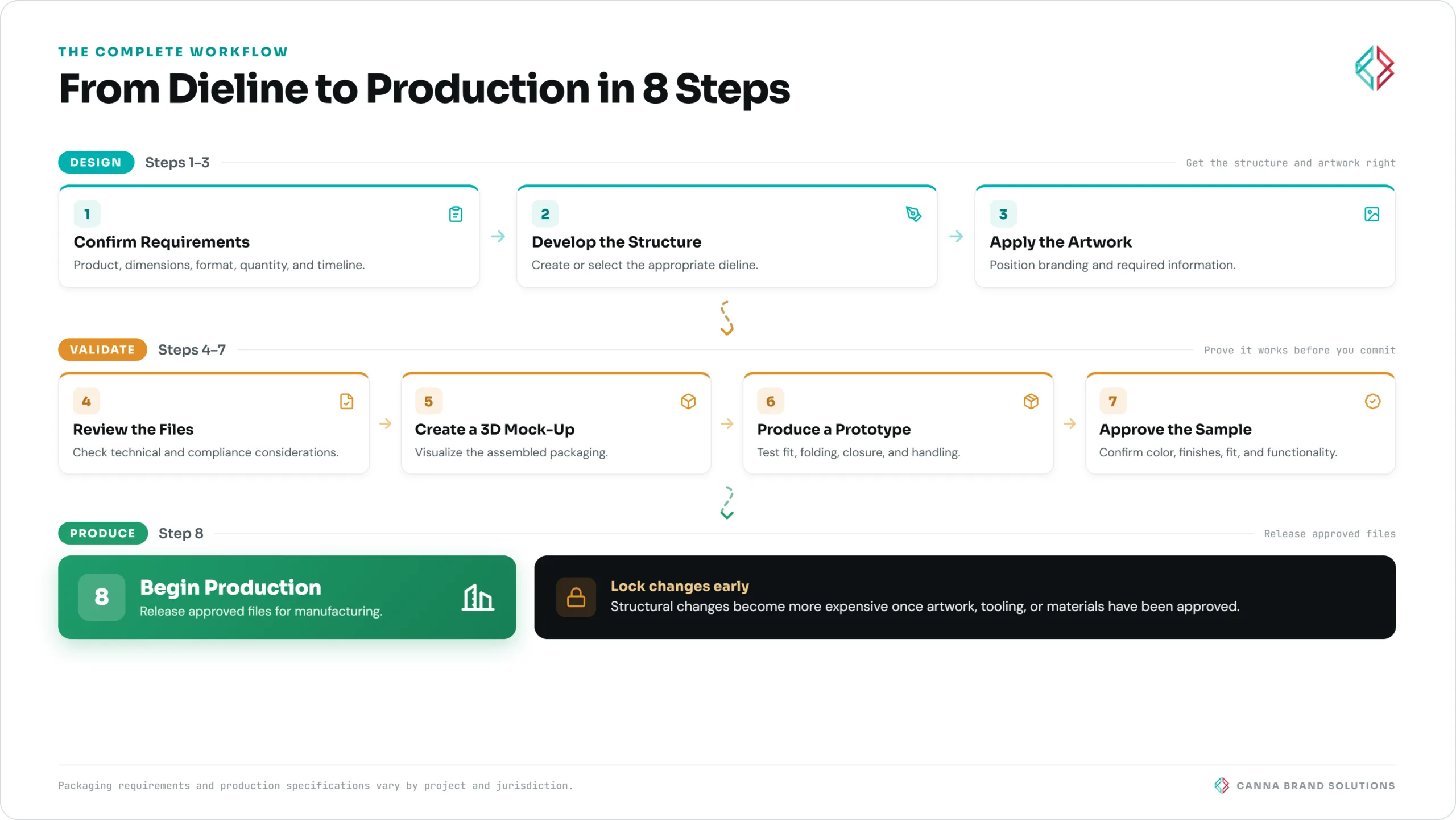
From Dieline to Production: A Typical Workflow
- Confirm the product dimensions and packaging format.
- Develop or select the structural dieline.
- Place artwork and required information within approved zones.
- Conduct technical artwork and compliance reviews.
- Generate a digital mock-up or 3D rendering.
- Produce and test a physical prototype.
- Approve color, finishes, fit, and functionality.
- Release the final files for mass production.
Completing these steps in sequence helps prevent structural changes from being introduced after artwork, tooling, or materials have already been approved.
Cannabis Packaging Dieline Checklist
Before submitting packaging artwork, confirm that:
- The latest approved dieline is being used.
- The dieline has not been resized, stretched, or altered.
- Artwork is prepared in the required color mode.
- Images meet the printer’s resolution requirements.
- Bleed extends beyond every relevant cut edge.
- Logos, regulatory copy, and codes remain inside safe zones.
- Fonts are outlined or packaged correctly.
- Linked images are embedded or supplied.
- Special finishes appear on clearly labelled layers.
- Glue zones and functional areas remain unobstructed.
- Barcodes and QR codes have adequate size, contrast, and quiet space.
- The assembled panel orientation has been checked.
- Regulatory content has been reviewed for the intended jurisdiction.
- A physical prototype has been approved before mass production.
Requirements vary by structure, material, printing method, manufacturing partner, and jurisdiction. Always work from the specifications supplied for your specific project.
In Conclusion: How Consistent Dielines Accelerate Your Cannabis Packaging Production
Cannabis packaging dielines determine whether your production runs smoothly or gets stuck in revision cycles. When your dielines are accurate, consistent, and tested before mass production, you move products to market faster and spend less on rework and compliance corrections.
The investment in proper dieline development pays returns across every project. Templates built to professional standards adapt efficiently for new SKUs. Review processes catch problems early. Production partners can focus on quality rather than correcting file errors.
Canna Brand Solutions helps cannabis manufacturers and brand managers develop packaging that performs from design through delivery. With in-house design services, established manufacturing partners, and expertise in cannabis compliance requirements, we help brands eliminate the surprises that slow production and increase costs. Contact our team to discuss your packaging needs and learn how consistent dieline standards can speed up your next product launch.
Start With a Proven Dieline—or Build Something Fully Custom
Not every packaging project needs to begin from scratch. Canna Brand Solutions maintains a library of tried-and-true dielines and packaging formats that have already moved through testing and production workflows. This gives brands a range of proven options to evaluate, helping shorten structural development and simplify the path to production.
When an existing format does not meet the product, branding, or functional requirements, a fully custom dieline can be developed. Our team can support the entire process—from structure selection and artwork setup to prototyping, testing, revisions, and final production.
Testing and compliance requirements vary by packaging format, product, and jurisdiction. Our team can help identify the appropriate documentation and validation requirements for each project.
Why Work With Canna Brand Solutions?
Canna Brand Solutions connects structural packaging development, artwork review, prototyping, customization, and production coordination within one process. Our team helps identify file, fit, finishing, and presentation issues before they become manufacturing problems.
Depending on the project, support may include:
- Structural dieline development and verification
- Artwork and production-file review
- Digital mock drafts and 3D product renderings
- Material and finishing recommendations
- Physical sampling and approval coordination
- Custom packaging production
This coordinated approach gives brands greater visibility from initial concept through final delivery.
Preparing a new packaging launch or correcting an existing dieline? Send Canna Brand Solutions your product dimensions, packaging format, artwork files, target quantity, and desired launch date. Our team can review the project requirements and help identify potential structural or production issues before mass production begins.
Contact Canna Brand Solutions to discuss your next custom packaging project.
FAQs about Cannabis Packaging Dielines
How do accurate dielines speed up cannabis packaging production?
Accurate dielines reduce prepress corrections, sampling rounds, tooling changes, and assembly problems. By defining every cut, fold, bleed, safe zone, and functional area before production begins, brands can move from artwork approval to manufacturing with fewer delays and less rework.
What is a dieline in cannabis packaging?
A dieline is a flat technical template that shows where your cannabis packaging will be cut, folded, scored, and glued. Canna Brand Solutions uses dielines as the foundation for all custom packaging projects, ensuring your regulatory elements and brand graphics appear correctly on the finished product.
Why do dieline errors cause production delays?
Dieline errors require file corrections, sample revisions, and sometimes new tooling before production can proceed. Missing bleed, incorrect panel orientation, and unsafe content placement are common issues. Canna Brand Solutions catches these problems during design review before they affect your timeline.
How do dielines affect child-resistant packaging compliance?
Your dieline determines where child-resistant mechanisms are positioned and whether they function correctly after assembly. If locking tabs, push-and-turn features, or squeeze-to-open mechanisms conflict with your structural design, the packaging may fail compliance testing.
What should be included in a cannabis packaging dieline?
A complete dieline includes cut lines, fold lines, bleed areas, safe zones, glue tabs, and panel dimensions. For cannabis products, your dieline should also account for warning label placement, THC symbol positioning, and any child-resistant feature requirements.
How can I test my dieline before mass production?
Request a white dummy sample to test structure and fit without final printing. Canna Brand Solutions provides digital mock drafts and 3D product renders to visualize your packaging, followed by physical samples that confirm everything works before production begins.
What causes barcode scanning problems in cannabis packaging?
Barcodes placed across fold lines, too close to edges, or in low-contrast areas may not scan after assembly. Your dieline should position barcodes within safe zones on flat panels. Canna Brand Solutions reviews barcode placement during artwork verification to prevent scanning issues.
How do I maintain dieline consistency across multiple product SKUs?
Establish dieline templates and standards that apply across your product line. Document acceptable tolerances, review processes, and approval criteria. Canna Brand Solutions helps brands develop consistent dieline systems that make new product launches faster and more predictable.
Packaging and labeling requirements vary by product category and jurisdiction. The information in this article is intended for general packaging-planning purposes and does not constitute legal or regulatory advice. Brands should confirm current requirements with qualified compliance professionals and the applicable regulatory authority before production.